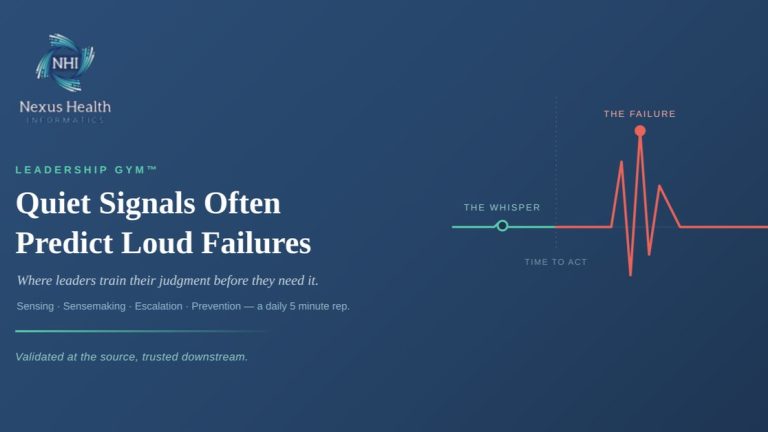

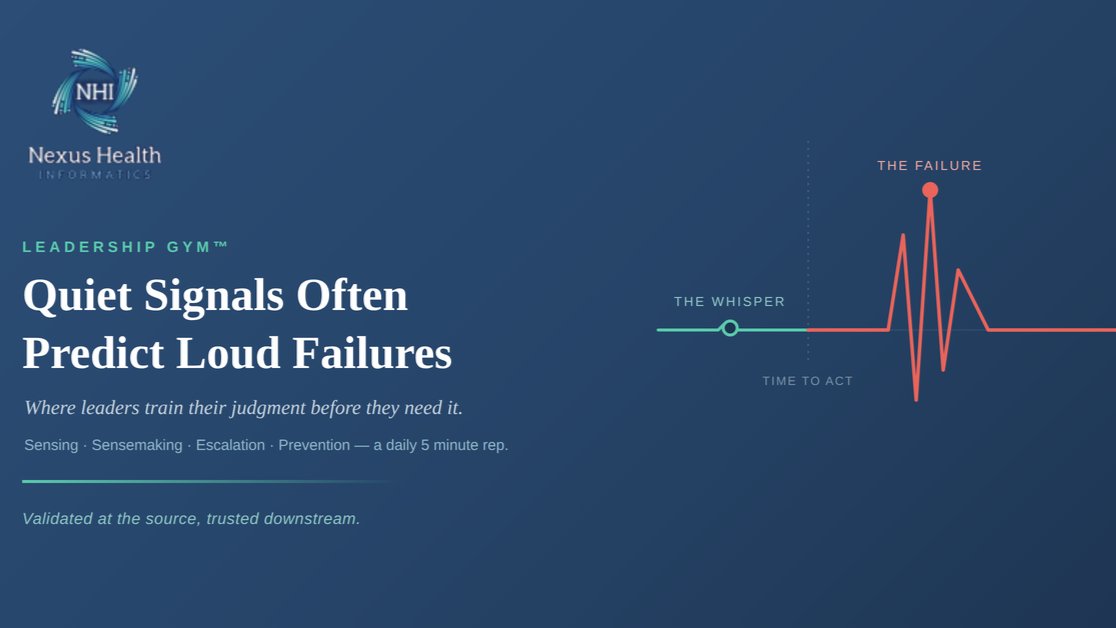
Organizational failures almost always look sudden from the outside. From the inside, they rarely are. Before a crisis becomes public, there are usually quiet signals: a metric slowly drifting off course, a concern raised gently and then dropped, a near-miss that got documented and never made it to a leadership conversation.
This pattern shows up across decades of research on high-reliability organizations — aviation, nuclear power, healthcare. Weick and Sutcliffe describe “preoccupation with failure” as one of the defining traits of organizations that avoid catastrophe: they treat small anomalies as information about the health of the whole system, not as isolated exceptions to wave away.
Christianson and Barton’s analysis of organizational responses to COVID-19 found the same thing: organizations that updated their understanding based on early, weak signals responded faster than those waiting for a clearer picture to emerge. And Diane Vaughan’s study of the Challenger disaster gave us the term for what happens when we don’t do this — “normalization of deviance,” where a warning sign is observed repeatedly and each time gets quietly reclassified as an acceptable risk instead of a signal worth escalating.
In healthcare, this shows up as protocol deviations that slowly become routine, or bias in an AI risk-prediction tool that goes unaddressed because no one flagged it early enough.
Three exercises to build this skill:
- Review a recent near-miss that never got escalated. Ask why not.
- Find one metric that’s been slightly drifting and investigate it now, before it becomes a bigger problem.
- Identify one thing your organization has normalized that probably shouldn’t be.
With 2027 prior authorization mandates and AI-driven clinical workflows on the way, this kind of early signal detection isn’t optional — it’s how organizations catch the quiet problems before they become loud ones.
This is the thirteenth installment of the Leadership Gym™ series.
Originally published on LinkedIn as part of The Whisper Before the Roar series (#13).